
"when you're young, everything feels like the end of the world. (but it's not, it's just the beginning.)"

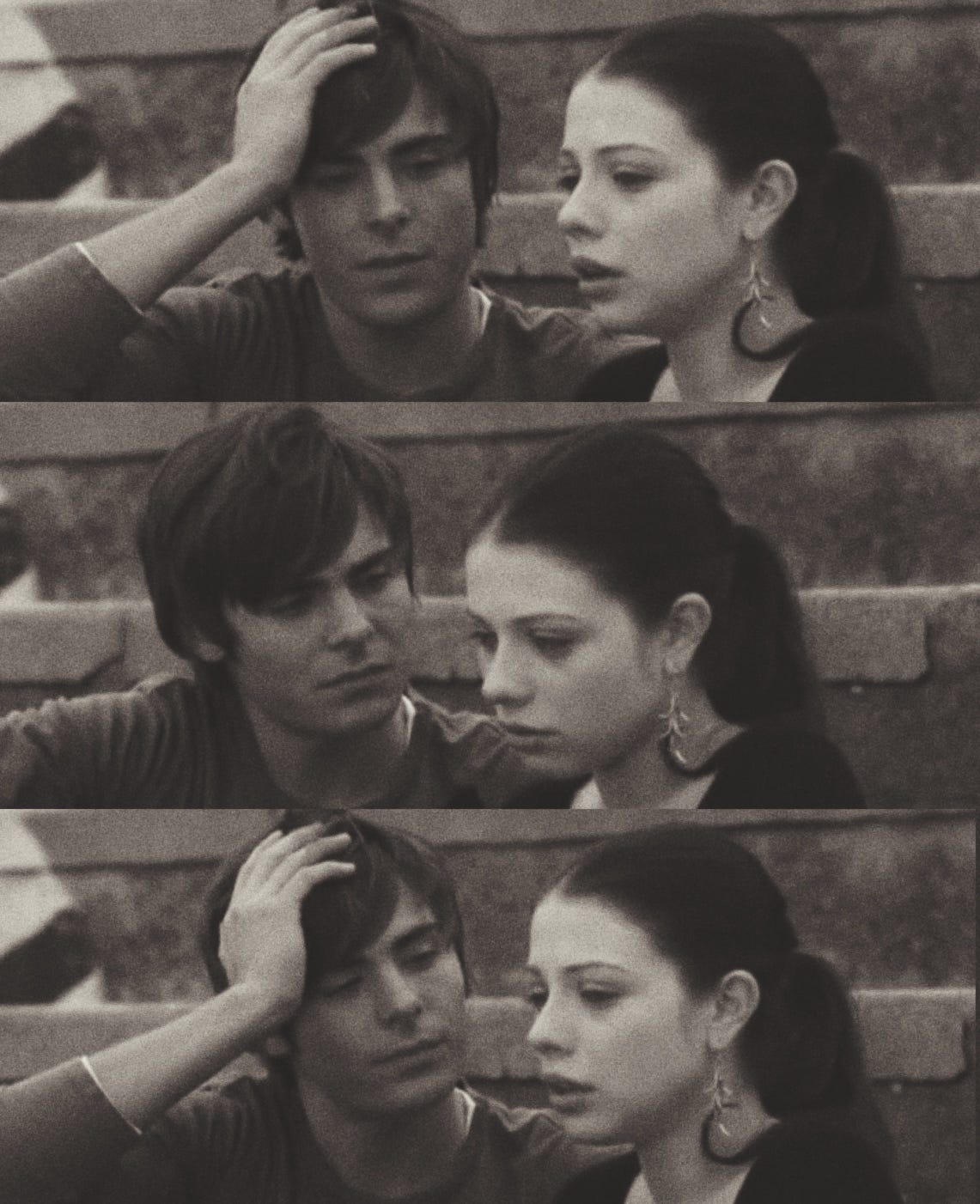
My favourite movie isn’t some highbrow indie film with an ambiguous ending or philosophical questioning. It’s not one that makes me look deeply cultured or intellectually superior. It’s 17 Again, the 2009 Zac Efron rom-com. For so many reasons, but specifically the line: “when you’re young, everything feels like the end of the world. but it’s not, it’s just the beginning.”
Because we’d be lying if we said we didn’t find life’s greatest truths in the most unassuming places, like right under the over-saturated glare of a mid-2000s movie.
By no means am I this sage elder. Matter of fact, I think I’ll always be young and feeling and constantly changing my definitions of what constitutes the apocalypse. Right now, I’m old enough to know better (in some cases), yet still young enough to be utterly flattened by a Tuesday afternoon. I’m still so young, but I am not without a handful of nights where I laid face down on the carpet and genuinely believed I was watching the credits roll on my own life.
I remember every detail of every loss and every heartbreak that felt like literal evictions from my own skin. There were people who were supposed to be here forever. People who were supposed to love you or be beside you until the wheels fall off. It’s like we assign this permanent eternity to people we love, a crown they maybe never even asked to wear. It almost feels like we set ourselves up to have our hearts shattered in choosing to love that way, that deeply. But part of you knows the risk, and part of you doesn’t care what happens anyway because this love, this right now, is too beautiful. It is too worth the wreckage and nothing like you’ve ever known.
And then the lights go out and you’re sat there on the floor with this immeasurable pain, thinking: I don’t get up from here. This is it. The story ends here.
But the sun is so violently indifferent to your grief. It unfortunately does not pause for the nine-year relationship ending or because a heart stopped beating. It doesn’t check to see if you’re ready before it cracks open the sky with its light and forces you to drag your lifeless body into a tomorrow you didn’t ask for. You go to work with bloodshot eyes, you buy the groceries that’ll spoil in the fridge, you wash the dishes without even knowing that your hands are in the water. You become a ghost haunting your routine, questioning the life in every other person you pass by, while your entire universe is in pieces on the linoleum.
The thing is, every single person you encounter has something worth collapsing into a sobbing heap on the floor about. In fact, they have a universe in pieces on their linoleum too. But suffering makes us myopic. We all walk past each others’ ends-of-the-world every single day.
But there’s a quiet magic that happens for all of us, so slowly and subtly that we often don’t notice it in real time. We only ever notice the pain while it’s happening. But somewhere in between us all going through the motions and measuring our lives in the stark before and the after, the air shifts for a split second. You sit at a bar with someone new, or an old friend who never left, and you just laugh. It doesn’t even matter that you cried on the car ride home. These are fleeting, sacred proofs that you survived. You’re surviving.
Without even realizing it, we slowly take the disasters and shelf them. We start building these mental libraries of every apocalypse we’ve ever outlived. It is a terrifying archive stacked with betrayals, departures, unimaginable losses. But every time the ground starts to shake again, you can walk down those aisles, pull off a volume from three years ago, and remind yourself: I know this panic. I know this angle of the floor. And I got up last time.
As I get older, I know the definition of the “end of the world” is going to keep shifting. The stakes are going to get higher. The losses will get heavier, people will get sicker, parents will get older, love will get more complicated, and the world will keep violently rearranging its borders. I however, find this beautiful, gut-wrenching reassurance in knowing I am never going to be fully cured of emotional disaster.
Because if the bad can still feel that monumental—if the grief can still taste like the absolute end of the world—then imagine the alternative. If our nerve endings are always going to be sensitive enough to feel every jagged detail of the darkness, then they are still perceptive to the light. If we can build these massive libraries of all of the ends-of-the-worlds’, imagine the libraries of everything-we-ever-surviveds’.
Like 2009 Zac Efron said, it’s not the end of the world.
It’s just the beginning.
The library of every apocalypse you've outlived is the most underrated thing you own. Most people forget they built it.
Beautiful thought process. Life is a series of goodbyes, as explored in a book about the "Fourth Way." First impressions often don't go well or are not even intended to work out, leading to a need to go through the same dance again with someone who has been dancing to a different rhythm, vibe, or time signature.
So you keep going. You may feel a bit bruised and carry fewer or even no expectations. But you continue on, recognizing that leaving or arriving is up to you.
I really enjoyed this. Thank you!
(Maybe check out my writing/page; I would be so happy!)